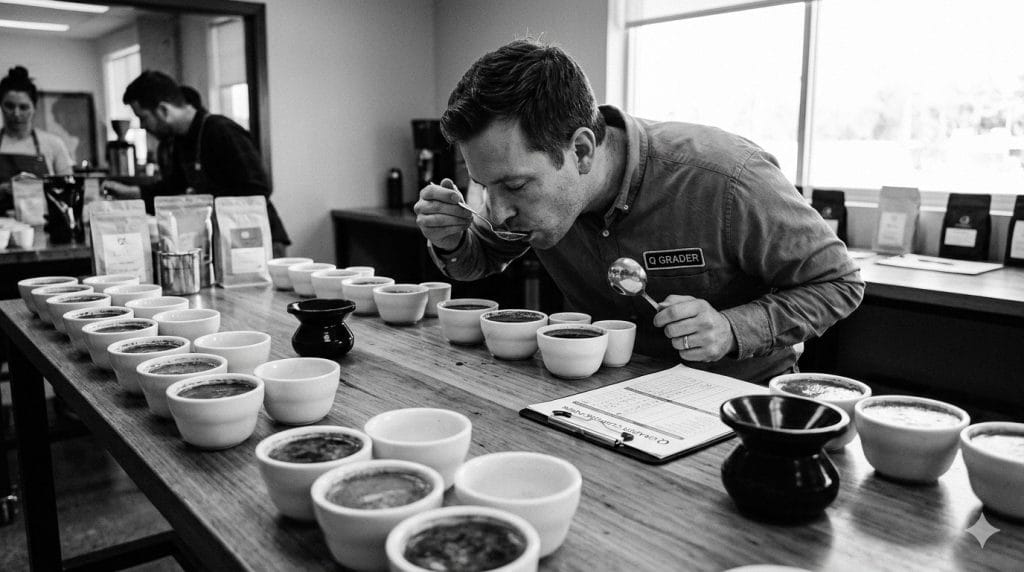
Specialty coffee grading is the system that decides whether a coffee is good enough to be called “specialty”. It has two parts: a physical check of the green (unroasted) beans, and a sensory evaluation called cupping, in which trained tasters score the roasted coffee out of 100. A coffee needs 80 points or more to be specialty grade.
This page explains how each step works, what the scores mean, and what the number on a bag of coffee can and cannot tell you. For the full picture, start with our guide to what specialty coffee is.
Step 1: grading the green coffee
Before roasting, a sample of green coffee (typically 350 grams) is spread out and checked for defects. Defects are split into two groups:
- Primary defects: serious problems such as full black beans, full sour beans, dried cherries, fungus-damaged beans and foreign matter.
- Secondary defects: smaller flaws such as partly black or partly sour beans, broken or shell beans, floaters and insect-damaged beans.
To qualify as specialty grade, a sample has no primary defects and only a very small number of secondary defects. Moisture content and bean size are checked as well. This filter alone removes most of the coffee grown in the world.
Step 2: cupping the roasted coffee
The coffee is then roasted to a standard light-to-medium profile, ground and brewed in a controlled way, and tasted by a Q Grader, a taster certified by the Coffee Quality Institute. Graders slurp the coffee from a spoon so it spreads across the whole mouth, and score it on the SCA cupping form. The cupping protocol and the grader certification are maintained by the Specialty Coffee Association (SCA) and the Coffee Quality Institute (CQI).
What is scored
- Fragrance and aroma: the smell of the dry grounds and of the wet coffee.
- Flavour: the main taste and aroma of the coffee in the mouth.
- Aftertaste: how long and how pleasant the flavour lasts after swallowing.
- Acidity: the brightness of the coffee. Good acidity feels lively, like the freshness of fruit.
- Body: the weight and texture of the coffee on the tongue.
- Balance: how well the flavour, acidity and body work together.
- Sweetness, uniformity and clean cup: consistency from cup to cup and the absence of off-tastes.
- Overall: the grader’s overall impression.
Each attribute is scored out of 10, and points are taken off for tastes that should not be there.
What specialty coffee grading scores mean
| Score | Class | In practice |
|---|---|---|
| 90 – 100 | Outstanding | Rare lots, often sold at auction for very high prices |
| 85 – 89.99 | Excellent | Clear, complex and distinctive |
| 80 – 84.99 | Very good | The entry level of specialty coffee |
| Below 80 | Not specialty | Commercial or commodity grade |
What a score does not tell you
A score is a useful signal, not a verdict. Three things to keep in mind:
- Taste is personal. An 87-point coffee you find sharp may be your friend’s favourite.
- The score belongs to a lot, at a moment in time. It describes the green coffee that was cupped, not how a café brews it months later.
- Not every roaster prints it. Many excellent specialty roasters list origin, process and tasting notes instead of a score.
Learning to taste for yourself is the best next step: see our guide to coffee tasting notes.
Frequently asked questions
Who gives coffee its score?
Certified Q Graders, following the cupping protocol of the Specialty Coffee Association (SCA).
Can a dark roast be specialty grade?
Yes. The score is given to the coffee as green beans and as a standard cupping roast. What a roaster does later is a separate choice.
Where can I taste specialty coffee?
Browse our Guide of specialty coffee shops around the world.