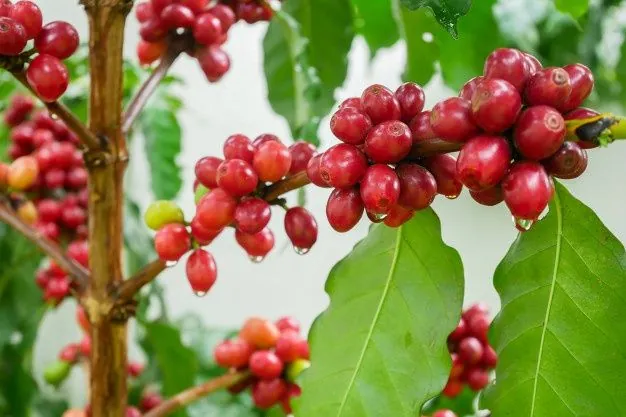
Arabica and robusta are the two coffee species that make up almost all the coffee in the world. Arabica (Coffea arabica) accounts for roughly 60% of production and nearly all specialty coffee. Robusta (Coffea canephora) makes up most of the rest and is common in instant coffee, espresso blends and commercial products.
They differ in taste, caffeine, where they grow and how they are farmed. Here is how to tell them apart. For the wider context, see what specialty coffee is.
Arabica vs robusta at a glance
| Arabica | Robusta | |
|---|---|---|
| Share of world production | About 60% | About 40% |
| Typical taste | Sweet, fruity, floral, bright acidity | Bitter, earthy, woody, low acidity |
| Caffeine | About 1.2% | About 2.2% (nearly double) |
| Altitude | Higher, often 600–2,000 m | Lower, often below 800 m |
| Climate and disease | Delicate and prone to disease | Hardy and resistant |
| Price | Higher | Lower |
| Crema in espresso | Light | Thick and persistent |
Taste
Arabica has a wide flavour range: berries, stone fruit, citrus, flowers, chocolate and caramel, depending on origin and process. Robusta tends toward bitter, rubbery or woody notes, with a heavy body. Because of that, robusta is often used where body and crema matter more than nuance, for example in traditional Italian espresso blends.
Caffeine
Robusta contains roughly twice as much caffeine as arabica. The extra caffeine acts as a natural defence against insects, and it also adds bitterness.
Growing conditions
Arabica prefers cool, high-altitude climates and grows slowly, which concentrates sugars and acids in the bean. It needs careful farming and is vulnerable to heat and diseases such as leaf rust. Robusta copes with heat, humidity and pests, grows at lower altitudes and yields more per plant, which is why it costs less. For independent research on coffee species and varieties, see World Coffee Research.
Is robusta always bad?
No. Most robusta is grown for volume, but there is a small movement of “fine robusta”: carefully farmed and processed lots that can be clean, sweet and chocolatey. It is still rare, and most specialty coffee is arabica.
How to choose
- If you want complexity and bright flavours, choose arabica, ideally single origin. See single origin vs blend.
- If you like a bold, thick espresso with a lot of crema, a blend that includes some robusta can work.
- Check the bag. Specialty roasters name the species and variety; if it only says “100% coffee”, you do not know what you are getting. Learn the main coffee bean varieties.
Frequently asked questions
Which has more caffeine, arabica or robusta?
Robusta, with roughly twice as much caffeine as arabica.
Is arabica better than robusta?
Arabica is generally preferred for flavour, and almost all specialty coffee is arabica. Robusta is valued for body, crema and caffeine.
Where can I try good arabica?
Browse specialty coffee roasters in our Guide.